Negative Ions and Ozone Are Not the Same: Why the Generation Method Matters
Negative ions and ozone are often mentioned together, but they should not be treated as the same thing.
Negative ions are electrically charged particles that are naturally associated with fresh outdoor environments such as forests, waterfalls, ocean air, and the air after rainfall. Many people describe these environments as feeling cleaner, fresher, and easier to breathe.
Ozone, by contrast, is O₃ — a highly reactive gas made of three oxygen atoms. Although ozone can be useful for industrial and disinfection purposes under controlled conditions, it is not suitable for direct inhalation in occupied indoor environments.
The key question is not simply whether a product mentions “negative ions.” The more important question is how those negative ions are generated — and whether the process can create ozone as a byproduct.
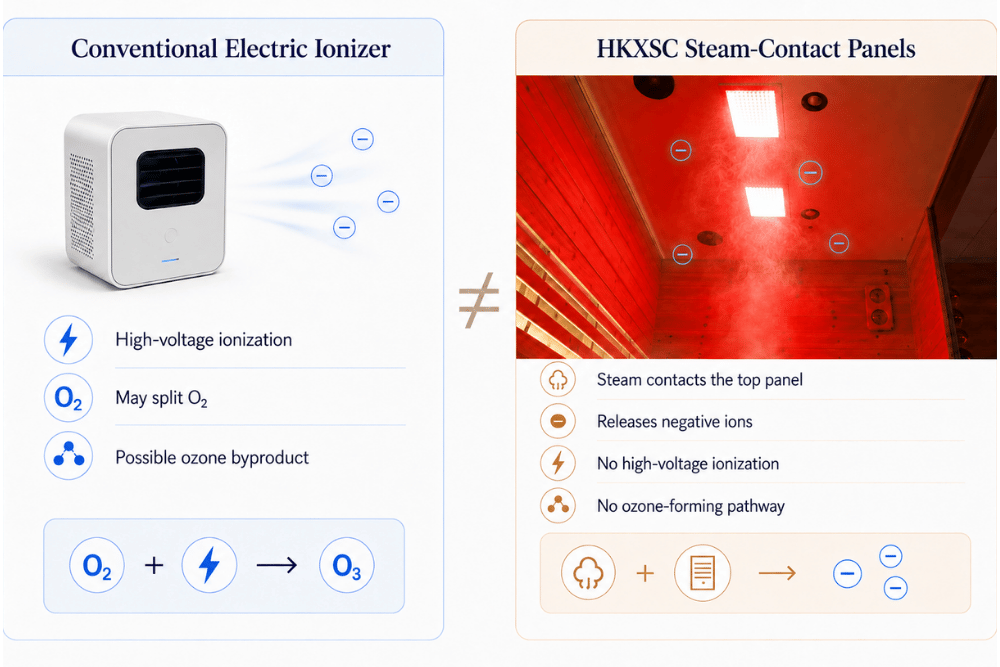
Not all negative ion technologies work the same way. Some devices use high-voltage ionization, plasma, or UV-based methods, which may create ozone as a byproduct if not properly controlled. HKXSC takes a different approach: negative ions are released when steam comes into contact with the negative ion panel. This process does not rely on electrical discharge, UV light, plasma, or ozone-generating chemical reactions, helping create a fresher and more comfortable sauna environment without producing ozone.
That distinction matters because different generation methods have very different safety profiles.
Negative Ions vs. Ozone: Two Different Things
| Item | Negative Ions | Ozone |
|---|---|---|
| Basic nature | Electrically charged particles or hydrated ions | O₃, a reactive gas made of three oxygen atoms |
| Natural association | Forests, waterfalls, rain, moving water, ocean air | Upper atmosphere; also formed by high-energy reactions |
| User experience | Often associated with fresh, clean-feeling air | Sharp odor; respiratory irritation risk indoors |
| Wellness relevance | Studied for potential mood and environmental comfort effects | Not a wellness gas for occupied indoor spaces |
Negative ions themselves are not ozone. The concern around some "negative ion" products comes from certain electronic ionizers that may generate ozone as a byproduct during operation.
Why Some Negative Ion Devices May Produce Ozone
Some conventional negative ion generators use high-voltage corona discharge or needle-point ionization. These methods apply a strong electric field to the surrounding air to create charged particles.
However, under sufficient energy, the same process may also affect oxygen molecules in the air. Oxygen molecules can be split into reactive oxygen atoms, which may then combine with oxygen molecules to form ozone as an unintended byproduct.
In simplified form:
O₂ + energy → O + O
Then:
O + O₂ + M → O₃ + M
This is how ozone can be formed: oxygen molecules must first be split into free oxygen atoms, and those oxygen atoms can then recombine with oxygen molecules to form ozone.
This is why some electronic ionizers and ozone-generating air cleaners have raised health and safety concerns. The problem is not negative ions themselves. The problem is the high-energy generation method that may create ozone as an unwanted byproduct.
Ozone Formation Depends on High-Energy Conditions
Warm, humid air or steam alone does not create ozone. Ozone formation requires enough energy to first split oxygen molecules into reactive oxygen atoms — a process typically associated with high-voltage discharge, plasma, short-wave UV light, or extremely high temperatures far beyond normal indoor or sauna conditions, roughly around 3000 K / 2700°C or higher.
| Ozone Formation Method | Can It Produce Ozone? | Explanation |
|---|---|---|
| High-voltage corona discharge | Yes | A strong electric field can split oxygen molecules and allow ozone formation |
| Needle-point ionization / high-voltage ionizer | Yes | Air ionization may also dissociate O₂ and create O₃ as a byproduct |
| Short-wave UV-C | Yes | High-energy ultraviolet light can break O₂ into oxygen atoms |
| Plasma / electrical arc / lightning | Yes | High-energy electrical environments can create free oxygen atoms |
| Normal steam / water vapor | No | Steam does not have enough energy to split O₂ molecules |
| Heat alone | Only at extremely high temperatures |
Meaningful O₂ thermal dissociation generally requires about 2700°C / 4890°F or higher |
A traditional steam sauna operates at normal sauna temperatures, not thousands of degrees. Meaningful O₂ thermal dissociation generally requires extremely high temperatures — around 3000 K / 2700°C or higher — far beyond any steam sauna environment. Therefore, steam heat alone is not a realistic pathway for ozone formation.
Also, ozone itself is thermally unstable. At elevated temperatures, ozone tends to decompose back into oxygen rather than remain stable.
Therefore, normal steam is not an ozone-producing mechanism.
How HKXSC Steam Saunas Generate Negative Ions Differently
HKXSC releases negative ions through natural contact between warm steam and the negative ion panels. Unlike conventional ionizers, UV-based systems, plasma devices, or high-voltage methods that may create ozone as a byproduct, HKXSC does not rely on these ozone-generating processes. Instead, it helps recreate the clean, refreshing comfort of air after rainfall, allowing you to enjoy a fresher, safer, and more comfortable steam sauna experience.
| Comparison Point | High-Voltage Negative Ion Generator | HKXSC Steam-Contact Negative Ion Panel |
|---|---|---|
| Main mechanism | Electrically ionizes air | Steam contacts negative ion panels |
| Energy source | High-voltage electric field | Warm steam contact |
| Does it split O₂? | May split O₂ during discharge | No O₂-splitting pathway |
| Ozone byproduct risk | Possible, depending on device design | No ozone-generating process |
| Technology category | Electronic ionizer | Steam-contact negative ion panel |
The key difference is how the negative ions are released. HKXSC uses steam contact with negative ion panels, rather than high-voltage air ionization. This contact-based method does not split oxygen molecules or rely on ozone-generating ionizer technology, so it should not be confused with conventional ionizers that may create ozone as a byproduct.
Because the process does not split oxygen molecules, it should not be confused with ozone-generating ionizer technology.
Why Ozone Can Be Harmful Indoors
Ozone is a strong oxidizing gas. When inhaled, it can irritate the respiratory system and aggravate breathing discomfort.
Potential effects of indoor ozone exposure may include:
| Potential Effect | Explanation |
|---|---|
| Throat irritation | Ozone can irritate the respiratory lining |
| Coughing | Respiratory irritation may trigger coughing |
| Chest tightness | Ozone may aggravate breathing discomfort |
| Shortness of breath | Sensitive users may feel reduced respiratory comfort |
| Asthma aggravation | Ozone may worsen asthma or reactive airway symptoms |
| Lung tissue irritation | Ozone can promote airway inflammation under exposure conditions |
These concerns are why ozone-generating devices are not ideal for occupied indoor wellness spaces. Ozone-related risks come from mechanisms that can produce ozone, such as certain high-voltage ionizers, UV-based systems, or plasma processes. They should not be automatically associated with all negative ion technologies. HKXSC steam saunas use steam contact with negative ion panels to release negative ions, rather than ozone-producing mechanisms, so the two should not be confused.
Why Negative Ions Are Used in Wellness Environments
Negative ions are widely associated with natural environments such as forests, waterfalls, ocean air, and rain. These environments often feel fresher and more comfortable because of humidity, air movement, natural aerosols, and charged particles in the air.
Negative ions have also been studied for potential wellness-related effects.
A more responsible way to interpret the research is:
| Research Area | What the Research Suggests | Responsible Interpretation |
|---|---|---|
| Mood-related outcomes | High-density negative ion exposure has been associated with lower depression scores in some studies | Promising wellness-related evidence, not a medical treatment claim |
| Perceived air freshness | Negative ions are commonly associated with fresh natural environments | Useful for describing a cleaner-feeling sauna environment |
| Biological mechanisms | Research reviews discuss possible links with inflammation, antioxidation, energy metabolism, and serotonin-related pathways | Mechanisms remain under investigation |
| Sleep, anxiety, and general relaxation | Evidence is not consistently strong across all outcomes | Best understood as support for relaxation, winding down, and a more comfortable wellness routine. |
| Airborne particle interaction | Charged particles may interact with dust and airborne particles | Formal air-purification claims require product-specific testing |
HKXSC uses negative ions as part of a fresher, more comfortable steam sauna experience. We do not present negative ions as a cure, treatment, or disease-prevention technology.
Negative ions and ozone are not the same thing
Ozone concerns mainly come from certain high-energy technologies, such as high-voltage corona discharge, needle-point ionization, UV-C, plasma, or electrical arc systems. These methods may split oxygen molecules and allow ozone formation.
Unlike high-voltage ionizers, UV-C, plasma, or electrical arc methods that may split oxygen molecules and create ozone, HKXSC steam saunas release negative ions through warm steam naturally contacting the negative ion panels — a contact-based process that does not follow an ozone-generating pathway.
In other words, the concern is not negative ions themselves, but whether the method used to generate them can also produce ozone. HKXSC avoids this confusion by using steam contact with negative ion panels, rather than ozone-generating ionizer methods.
HKXSC uses negative ions responsibly: not as a medical treatment, but as a comfort-focused feature designed to support a fresher, cleaner-feeling, more breathable steam sauna environment.
The following references are provided to help explain the scientific background of negative ions and their association with fresh natural environments, air comfort, and wellness-related experiences. They are included for educational purposes and should not be interpreted as medical claims or guarantees of specific health outcomes:
- Jiang, S. Y., Ma, A., & Ramachandran, S. (2018). Negative Air Ions and Their Effects on Human Health and Air Quality Improvement. International Journal of Molecular Sciences.Read the study.↗
- Duan, M., et al. (2021). Negative Ion Purifier Effects on Indoor Particulate Dosage to Small Airways. International Journal of Environmental Research and Public Health.Read the study.↗
- Chu, C. H., et al. (2019). The effects of negative air ions on cognitive function: an event-related potential study. International Journal of Biometeorology. Read the study.↗
- Kim, M., et al. (2021). Negative Air Ions Alleviate Particulate Matter-Induced Inflammation and Oxidative Stress in the Human Keratinocyte Cell Line HaCaT. Annals of Dermatology. Read the study.↗
- Xiao, S., et al. (2023). Biological effects of negative air ions on human health and integrated multiomics to identify biomarkers: a literature review. Environmental Science and Pollution Research.Read the study.↗